

A Marathon of Minds with CLDP: Drafting a Global Guide to Alternative Dispute Resolution
What happens when you place top international lawyers and mediation experts in a room and ask them to participate in a collaborative policy writing – in five days? You might anticipate endless debates, overlapping edits, and fierce clashes of opinion. Instead, our recent Book Sprint in Bonn, Germany, delivered a masterclass in collaboration, a complete manuscript drafted by day two, finalized by day five, and a lot of moral support from a local stray cat.
We couldn’t have asked for a better way to finish strong in 2025.
Last December 1 to 5, 2025, we worked alongside our long-time partners, Commercial Law Development Program (CLDP), and gathered a group of experts at the German Arbitration Institute (DIS) to tackle a pressing global issue. As participant Dr. Emad Hussein perfectly described it, the experience was “a true writing marathon… turning an exhausting week into an exhilarating one.”
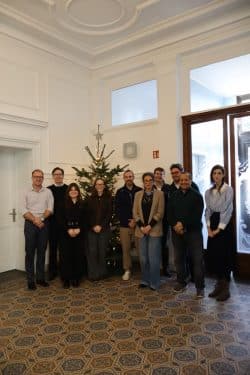
ADR participants
The Mission: Unclogging the Global Legal Bottleneck
Legal systems around the world are frequently backlogged, making litigation an incredibly slow and expensive avenue for resolving business and international conflicts. The primary objective of this Sprint was to create a concise, highly practical collaborative policy handbook on Alternative Dispute Resolution (ADR), specifically arbitration and mediation, for developing countries, with a spotlight on the Middle East and Eastern Europe.
CLDP needed a resource that went beyond dense legal theory. They wanted a guide that clearly explained how ADR mechanisms act as a fast, cost-effective alternative to traditional court battles.
To achieve this, the author pool was carefully curated. The group of eight authors included six international legal experts and two CLDP organizational staff. This composition was strategic for collaborative policy writing: while the lawyers brought deep, practical experience in international arbitration and mediation, the CLDP staff ensured the content remained accessible. They acted as the ultimate filter, making sure that readers without a heavy legal background could easily understand the steps of the mechanism and exactly who to call when a dispute arises.
The Ultimate Test: Convincing Lawyers to Embrace Collaborative Editing
Writing a policy handbook in five days is always a high-pressure environment, but this Sprint came with its own unique set of hurdles. First, one of the key experts joined the group only on day two, meaning the team had to quickly integrate a new voice into a fast-moving process.
Second, the methodology itself posed a significant challenge. For legal professionals accustomed to scrutinizing every comma, the Book Sprints approach to collaborative editing was a shock to the system. Letting go of the familiar “track changes” safety net was especially daunting. Early on, several participants hesitated, worried that without controlled revisions, the text’s quality would suffer. Yet, this fluid process is exactly what drives the method. By eliminating tracked changes, Book Sprints force fast-moving revision cycles, compel co-authors to take full ownership of their sections, and encourage open group discussion over buried document comments.
Overcoming this hesitation relied heavily on strong facilitation to help the group understand the mechanics of the Book Sprints method. Through active, guided intervention, our facilitator demonstrated how this fluid, track-free approach actually drives momentum and builds a more cohesive text. Once the participants understood the “why” behind the method, they began to trust the process and bring their editorial differences into open discussions. Of course, having a room full of professional mediators was the perfect bonus. Their natural ability to navigate conflicting opinions and communicate effectively made these facilitated discussions exceptionally smooth.
Book Sprint facilitator Alyssa Khouri leads the group in our Day 1 icebreaker activity. By physically moving around the room to answer prompts and being challenged to step out of the comfortable “middle ground”, participants practice the decisive communication and teamwork required to co-author a book
A Seamless Symphony (With a Little Help from a Feline Friend)
The environment in Bonn played a massive role in the Sprint’s success. Taking place in December, the week was steeped in the local holiday spirit. The U.S. government participants had just come off a shutdown, making the gathering feel like a much-needed celebration. The team enjoyed German Christmas treats at the venue, watched the institute decorate its tree, and even took a well-deserved evening trip to the bustling Christmas markets.
Because the DIS institute was located just outside the city next to a farm, breaks were spent taking walks to see the neighboring horses and cows. But the true VIP of the week was a local stray cat named Zelda. Zelda became the unofficial therapeutic mascot of the Sprint, forming a particularly tight bond with some participants. In a high-stakes writing environment, Zelda provided the perfect grounding presence.

Hyper-collaboration in action: one to hold Zelda the cat, one to hold the cup, and one to handle the “purr-fessional” quality control.
From Blank Page to Global Blueprint
The results of this collaborative energy spoke for themselves. The team was extraordinarily high-performing, closing the initial drafting phase by the end of day two. The shared vision among the authors made the subsequent editing phases incredibly smooth.
The final outcome, Alternative Dispute Resolution: Practice & Governance for States, is a comprehensive asset for global trade. Uniquely, the collaborative environment allowed the authors to develop a brand-new chapter detailing exactly how CLDP can act as a thought partner in helping governments set up their own ADR systems, a feature that wasn’t initially planned but became one of the book’s greatest strengths.
With plans to present the book at upcoming international conferences, distribute it as a digital tool, and hand physical copies to organizations during CLDP’s global travels, this handbook is set to streamline legal processes and enhance commercial stability in emerging economies worldwide. This is another testament that writing a policy handbook doesn’t have to take months. With the right facilitation and highly devout teams, it can take just days.
Contact us today at contact@booksprints.net to learn how we can guide your organization through your own Book Sprint.